

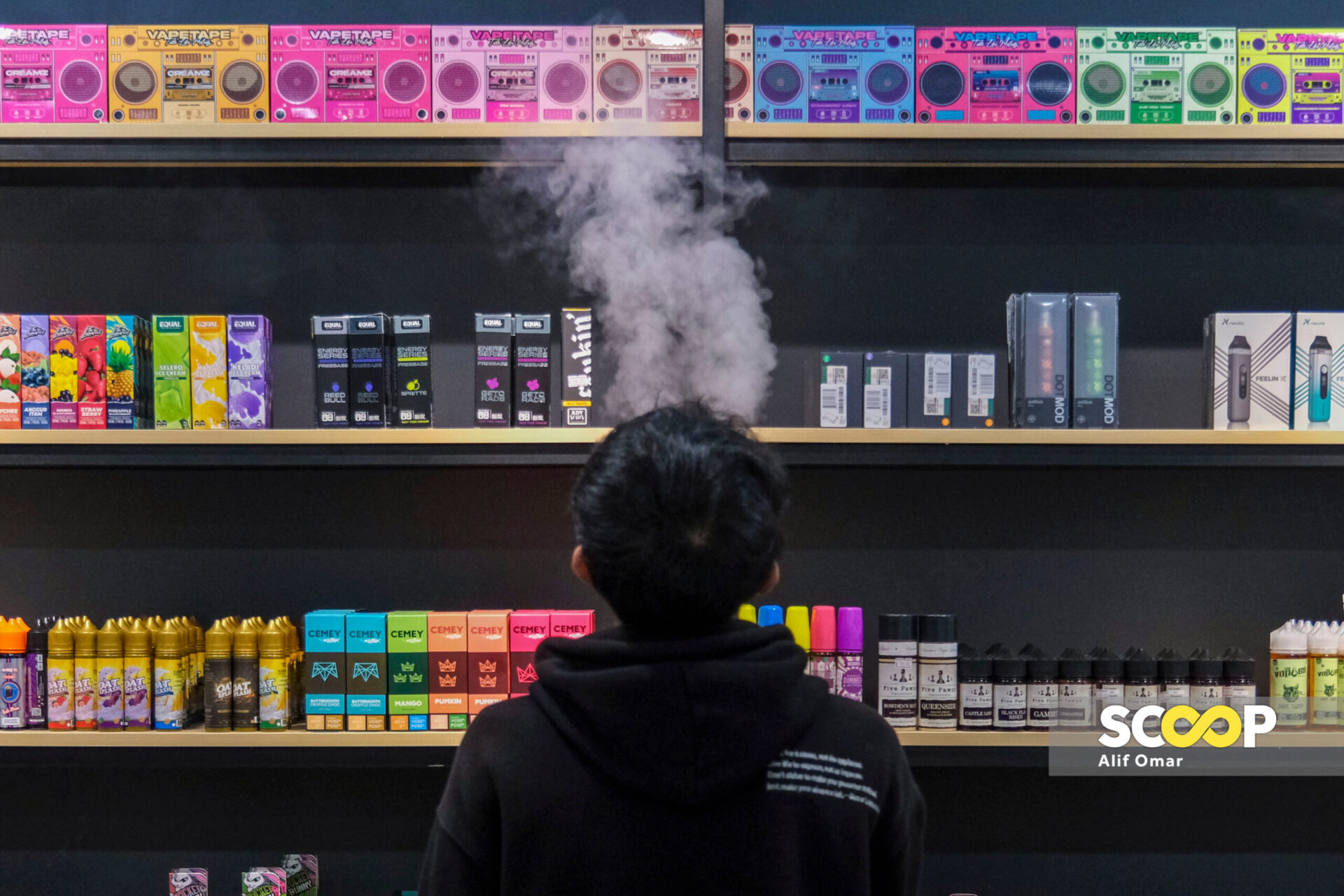

KUALA LUMPUR – The Malaysian Organisation of Vape Entity (MOVE) president Samsul Kamal Ariffin has criticised the Health Ministry’s proposal to raise the excise duty on vape liquids by 900%, calling the plan “illogical” and counterproductive to public health objectives.
Samsul’s response came after Deputy Health Minister Lukanisman Awang Sauni told Parliament that the ministry would recommend increasing the vape liquid tax from 40 sen per millilitre to RM4 per millilitre, as part of broader measures to curb use among teenagers and students.
Lukanisman said the proposal would be submitted to the Finance Ministry (MoF) ahead of Budget 2026 and described the tax hike as an “immediate step” before the government proceeds with a full ban on vapes and e-cigarettes.
He added that a Cabinet memorandum on the proposed ban would be tabled this year, following mounting pressure from parents, community leaders, and MPs.

Speaking to Scoop, Samsul said such a steep tax increase would make vape products more expensive than cigarettes, defeating their purpose as a less harmful alternative for smokers trying to quit.
“From a consumer perspective, it doesn’t make sense. If vaping is meant to help people stop smoking and is recognised as 95 per cent safer, how can the safer alternative be more expensive than tobacco?” he said.
Samsul stressed that vaping must be treated as a tobacco harm reduction (THR) tool, as it is in countries like the United Kingdom, where health authorities distribute vape products to smokers to help them quit.
“In the UK, vaping is accepted as a tobacco harm reduction method. Their health ministry even provides vape products to smokers. Until we accept vape as a THR tool in Malaysia, the laws we make will not make sense,” he said.
“If vape is taxed higher than cigarettes, people will be driven to the black market. We’ve seen this happen in countries like Australia, where banning vape led to illegal trade controlled by criminal networks. Even in Singapore, where vaping is banned, usage continues to rise.”
Samsul also warned that banning or excessively taxing vape products would harm all stakeholders — including public health, retailers, and the government.
“If vape is banned, people will still get the products, but they’ll be untested and unsafe. Retailers will lose their businesses, and the government will lose tax revenue. But if it’s regulated properly as a THR product, all three parties win,” he said.
At the same time, Samsul revealed that the MoF had recently engaged vape industry stakeholders, informing them of a potential tax increase from 40 sen per millilitre to 80 sen per millilitre — far below the 900% hike now suggested by the Health Ministry.
“About a month ago, we had a meeting with the MoF, and we were informed that the tax would increase from 40 sen to about 80 sen per millilitre, with the device tax remaining at 10%. So, this 900% figure is surprising and inconsistent with what we were told,” he said.
Samsul said the government must now make a policy choice that will determine the future of public health and the industry.
“We are at a crossroads. If we choose the wrong path, underage use and misuse will continue — but without any regulation. Retailers, public health, and the government will all lose. The solution is not to ban or overtax vape, but to regulate it properly,” he added. – October 7, 2025